Live AZ Co


Short-Term Rentals
as Tax Strategy

A working session with Josh Hogan

April 2026  ·  Phoenix, Arizona

Prepared for Jim and Ginny Sweeney

Who · Live AZ Co

Real estate is the business.
Short-term rentals are the strategy.


Live AZ Co is a Phoenix-based real estate company. Inside it, I run a small portfolio of design-forward short-term rentals that doubles as a tax strategy for the owners. Today I am walking you through one property end to end: 2007 W Medina Avenue in Mesa. Real return, real numbers, no aggregates and no averages.

Property shown end to end

1

Total basis

$965,936

Year-1 deduction

$238,399

Where you are

You have a tax bill coming.


Most people accept it. They write the check, watch the wire leave, and move on. There is another path the tax code has quietly allowed for forty years, and it works best when you have one large taxable event in front of you.

It is legal. It is IRS sanctioned. It works by buying an appreciating asset, putting it to a specific use, and letting the depreciation rules do something most CPAs never bring up unless you ask.

The next forty minutes are about whether this strategy fits you, and whether the math actually holds up when you see it on a real return.

The proof


Let me show you my 2024 return
for one property.

Everything that follows is taken straight off the Form 1065 I filed for 2007 W Medina Avenue in Mesa. Real numbers. Real schedules. Same property serves as our hero deal and our operating proof point.

2007 W Medina Ave · Basis waterfall

How a $750,000 house
becomes a $965,936 basis.


Land $134,012
Building structure (27.5-yr) $356,409
2024 remodel (27.5-yr) $131,626
Wiring and flooring (7-yr) $79,792
Appliances, furniture, fixtures (5-yr) $138,400
2024 launch furniture (5-yr) $89,800
Land improvements (15-yr) $35,897
Total depreciable basis $965,936
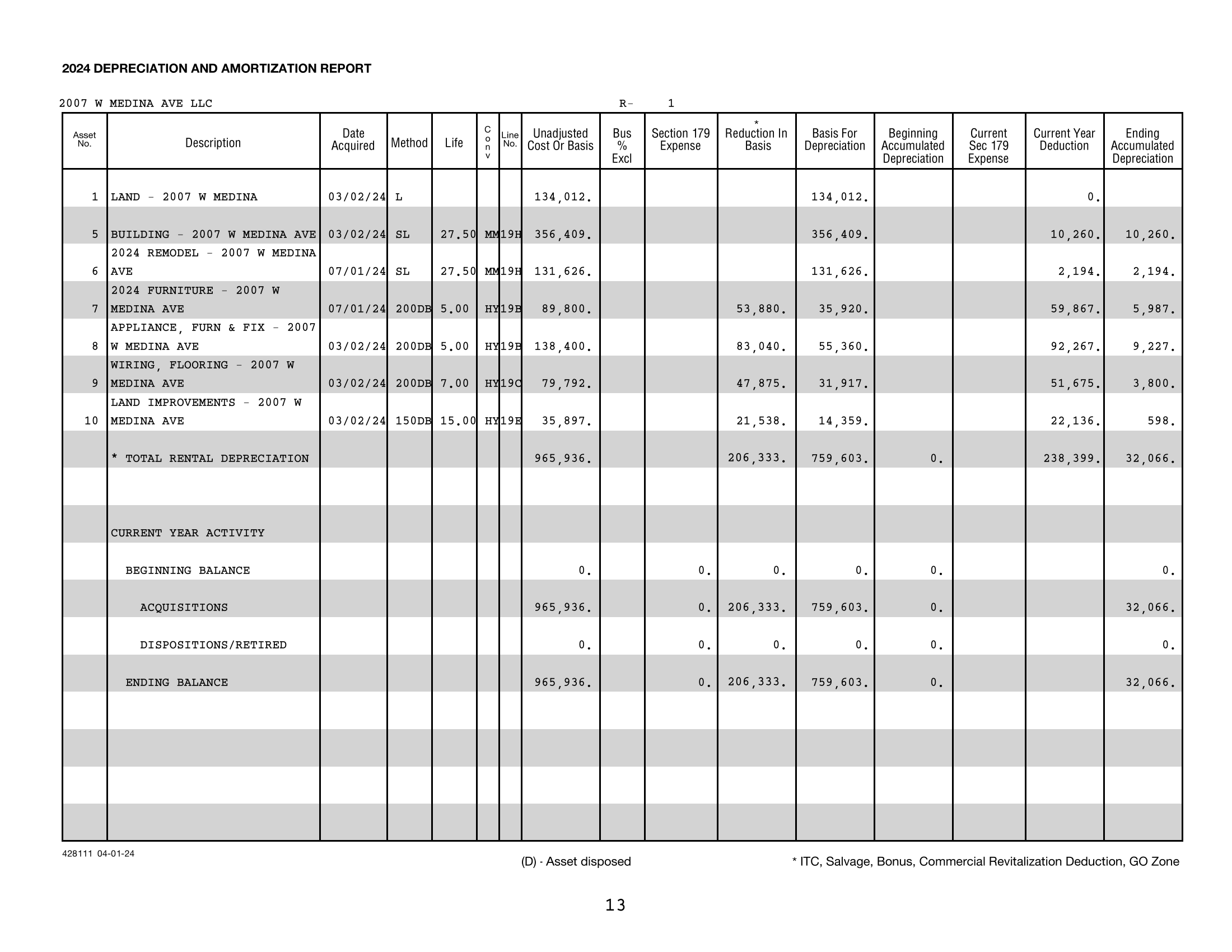
Form 4562 Depreciation Report excerpt

Source · 2007 W Medina Ave LLC · 2024 Form 1065 · Form 4562 Depreciation Report

The hero deal · 2007 W Medina Ave · Mesa AZ

The same deal, then and now.


2024 actual · 60% bonus · what I did

Cash in

$291,566

Year-1 depreciation

$238,399

Year-1 K-1 loss

−$248,436

Tax saved at ~32% blended

~$79,500

Cash on cash with tax benefit

~39.6%

Today · 100% bonus · OBBBA reset

Cash in

$291,566

Year-1 depreciation

$356,343

Year-1 K-1 loss

−$366,380

Tax saved at ~32% blended

~$117,242

Cash on cash with tax benefit

~52.6%

Cash in is identical. The asset is identical. The only thing that moved is the federal bonus depreciation rate. OBBBA permanently restored 100% bonus for property placed in service after January 19, 2025.

Source · 2007 W Medina Ave LLC · 2024 Form 1065 · Forms 4562, 8825, Schedule K. Right column applies 100% bonus to the same cost seg study. Tax savings depend on your personal return.

The line item · Schedule K, line 2

This is what shows up
on the K-1.
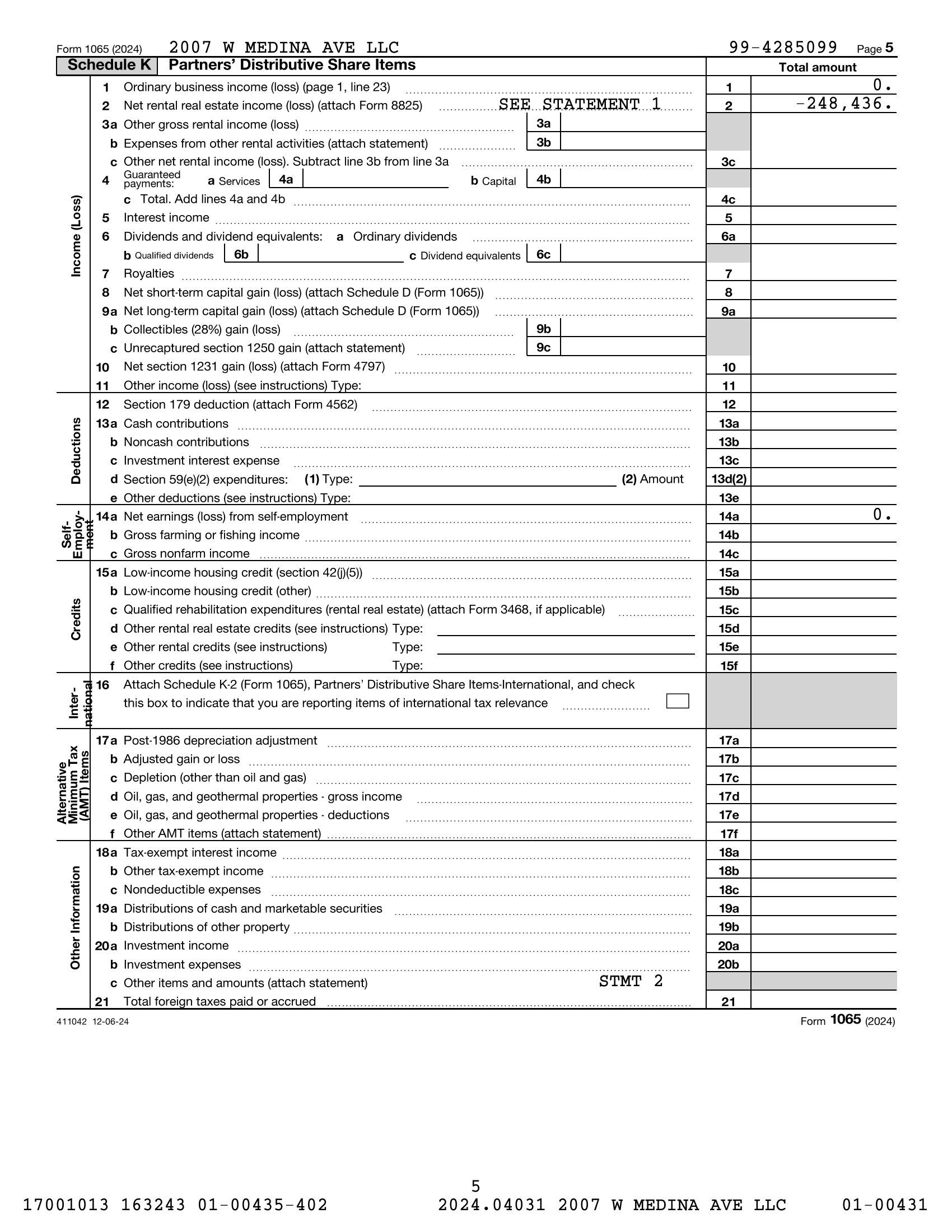

2024 Form 1065 Schedule K excerpt showing -$248,436 net rental real estate loss

Source · 2007 W Medina Ave LLC · 2024 Form 1065 · Schedule K, line 2

Net rental real estate loss −$248,436

That single line item is the entire pitch. It is reported on Form 8825, attached to the partnership return, and flows through the K-1 to the owner's personal 1040.

If you materially participate in a short-term rental with average guest stays under seven days, that loss is non-passive. It offsets ordinary income, capital gains, and one-time taxable events on your individual return.

Bonus depreciation · A short history

The window is open right now.


2017 TCJA introduces 100% bonus depreciation
2023 Phase-down begins at 80%
2024 60%, the year I bought Medina
Early 2025 40%, the trough
July 2025 OBBBA signed, 100% bonus permanently restored
2026 100% bonus is the law for property in service after January 19, 2025

I bought Medina at 60%. You would buy yours at 100%. That is a one-third bigger Year-One deduction on the same dollar of basis.

The five tests · Applied to 2007 W Medina

Every assumption I made,
the return now shows.


Revenue from compsComp pull, by bedroom and amenity tier
Underwrote
$145K to $165K Year 1 gross
$158,060actual 2025 gross revenue
Operating expensesPM, cleaning, utilities, insurance, taxes
Modeled
~$110K all-in steady state
$71,5672024 partial year, 151 days, Form 8825
Debt serviceReal lender quote at the time
Nonrecourse mortgage
$707,214, fixed
$39,8452024 interest paid, Form 8825 line 9
Cost seg tax benefitModeled at owner's marginal rate
Modeled
$230K to $250K at 60% bonus
$238,399Form 4562 depreciation report
Year-five exitStress test, recapture, cap rate move
Break-even at flat
upside at 3% AZ appreciation
Trackingyear 2 of 5

Source · 2007 W Medina Ave LLC · 2024 Form 1065 · 2025 operating P&L

Live walkthrough


Open the analyzer.

stranalyzer.vercel.app

  • Load Medina as the example
  • Edit price, rate, and rent in real time
  • Watch the cost seg panel recalculate
  • Walk the five-year projection
  • Stress test the exit at year five

Medina · Year one operations

And the property pays for itself.


The tax benefit is the headline. The operating P&L is the safety net. Medina's first full year on the calendar shows the deal cash flows on its own, before a single dollar of depreciation is counted.

2025 gross revenue

$158,060

Operating expenses

$122,062

Net operating income

$35,998

Operating margin

22.8%

Cash on cash, pre-tax

12.3%

Cash on cash, with tax benefit

~39.6%

Source · 2007 W Medina Ave LLC · 2025 full-year operating P&L. Cash on cash uses $291,566 capital invested. Tax benefit applied at ~32% blended.

Launch · Ninety days from close

From contract to first booking.


  • Days 1 to 7. Close, walk-through, locks rekeyed, utilities transferred.
  • Days 7 to 21. Punch list. Touch-up paint, fixtures, anything cosmetic the inspection flagged.
  • Days 14 to 60. Furnishing. Four to six weeks if you have a designer. Longer if you do not. Furniture lead times are the single biggest variable.
  • Days 60 to 75. Professional photography. Twilight shoot if the property has a pool.
  • Days 75 to 90. Listing live on Airbnb, Vrbo, and direct. First bookings inside two weeks of going live.

What usually breaks: HVAC, internet install, and at least one piece of furniture that arrives broken. Build a two-week buffer and assume something will need to be reordered.

Property management · Three models

Pick your involvement level.


Self-manage

You own the listing, the messaging, the calendar, the cleaners, the maintenance vendors. Maximum margin. Two to three hours per week per property in steady state, because the stack does the rest.

The stack · What I actually use

HostBuddy
AI guest messaging. Inbound questions, check-in instructions, upsells, review requests.

Hospitable
PMS and channel manager. Calendar across Airbnb, Vrbo, direct. Cleaner dispatch.

IntelliHost
Dynamic pricing. Sets nightly rates against the comp set, demand, seasonality, events.

Co-host

You keep ownership of the listing and vendors. A co-host handles guest messaging and turnover coordination for ten to fifteen percent. The model I run.

Full-service property manager

They run everything. You receive a monthly statement. Twenty to twenty-five percent of gross. Worth it if you live out of state, value your time at a high hourly rate, or own more than four properties.

What to ask any PM: their portfolio occupancy, average daily rate against comps, cleaner turnover rate, and how often they touch a listing.

Regulations · The Phoenix metro

Know the city before you write the offer.


  • Phoenix. Permit required, license posted on the listing, neighbor notification on application. Noise enforcement is active.
  • Scottsdale. Permit required, occupancy caps based on bedroom count, posted contact for complaints, two-strike rule.
  • Mesa and Gilbert. Lighter touch. Permit and TPT registration. Easier path to launch.
  • HOA risk. The single most common deal-killer. Read the CCRs before you remove inspection, not after.
  • Insurance. Use a short-term-rental specialist (CBIZ, Proper). Standard landlord policies will not cover you. Standard homeowner policies will deny claims.

Questions


Your turn.

Josh Hogan

Live AZ Co

(480) 369·2880

josh@liveazco.com

Appendix A · IRC §469 · The short-term rental exception

The thing nobody tells you.


For passive loss purposes, a short-term rental with an average guest stay under seven days is not classified as a rental activity. It is a trade or business. That single technicality changes everything that follows.

If you materially participate (one hundred hours per year, more than any other person on the property), the losses become non-passive. They flow through your tax return and offset ordinary income, including W-2 wages, business income, capital gains, and one-time events like an exit or vesting.

No twenty-five thousand dollar cap. No one hundred thousand AGI phase-out. No real estate professional status required. The only test is the average length of stay and your hours.

Appendix B · Cost segregation in plain English

Pull tomorrow's deductions
into today.


Traditional depreciation spreads the cost of a residential building over twenty-seven and a half years. Roughly three and a half percent per year. Slow, predictable, and not very useful when you have a one-time tax event.

A cost segregation study breaks the property into components. Personal property (appliances, cabinets, flooring, furniture) depreciates over five years. Land improvements (driveways, landscaping, pool decking) over fifteen. The structure itself stays at twenty-seven and a half.

Bonus depreciation then lets you take the entire five and fifteen year buckets in Year One. A property that would normally produce a small annual deduction produces a very large first-year deduction instead.

01  /  17